Club treasurer subs sheet
- Subs due for the season if every member pays
- 30,400.00
- Members on the list
- 240
- Subs collected so far
- 21,280.00
- Subs still owed (the arrears the treasurer is chasing)
- 9,120.00
Every figure here comes from the figures you enter and the method stated beside it: your members in each tier, your fees, your paid-up count, your fixed costs, your sessions and your register. Where a guide names a published figure it names the source and the date it was read. This site publishes no accounting, tax or charity-law advice: what your club's status requires of its books is your accountant's or your governing body's answer, and the guidance cited on each guide is the starting point, not the ruling.
The figures above start from a worked example (30,400.00). Change any input and the answer updates as you type, the way it will when the committee asks why the subs went up.
Download the Club treasurer subs sheet worked example (CSV)
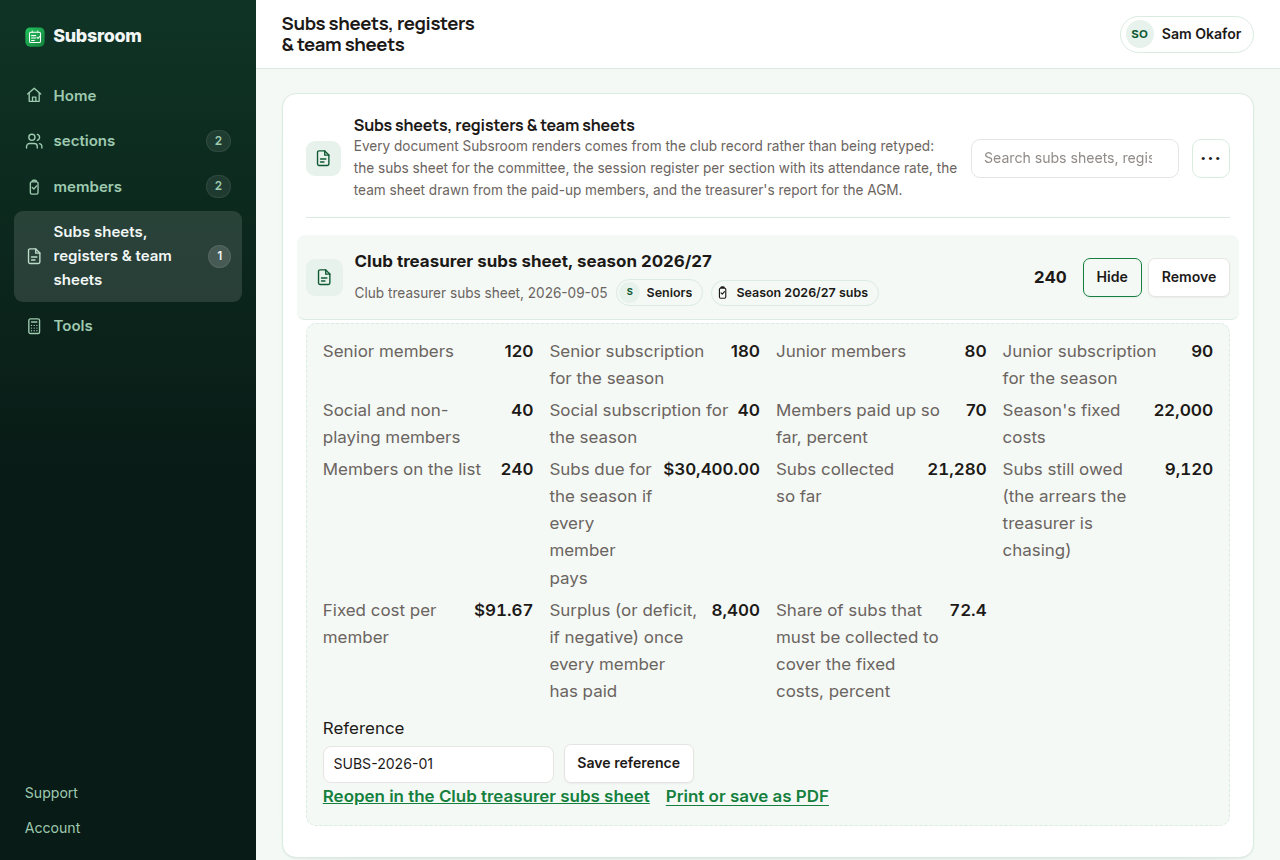
The club treasurer subs sheet works the season's money from the club's own list rather than last year's accounts: how many senior, junior and social members are on the list, what each tier pays for the season, what share of them have actually paid, and what the club owes for the ground, the affiliation, the insurance and the kit whether or not the subs come in. It returns the subs due if every member pays, the subs collected so far, the arrears the treasurer is chasing, the fixed cost per member, the surplus or deficit once everyone has paid, and the share of the subs the club has to collect before its fixed costs are covered. It is the sheet a treasurer builds in a spreadsheet every year, with the arithmetic written down so the committee can argue with the inputs instead of the answer.
Why the sheet asks for members by tier, not a total
A club's subs are not one figure times one number of members. Seniors pay one rate, juniors another, social members a third, and the mix decides whether the club is solvent: a club of two hundred and forty members that is a third juniors collects far less than one that is mostly seniors, at the same headline fee. The sheet takes each tier's count and fee and adds them, so raising the junior fee, capping the social tier or moving students to their own rate can each be tried on the page before the committee meeting, and the answer is the subs due for the season under that set of fees.
Arrears are a percentage until they are a list
The paid-up share is the honest figure most treasurers do not have in front of them: the members whose subs have cleared, not the ones who said they would pay at training. The sheet turns that share into the subs collected and the arrears still owed, which is the amount the club is running the season on credit for. On the worked example a club with seven in ten members paid up is owed almost a third of its subs in the second month, and that is the figure the reminders are sent about. Subsroom Pro keeps the same figure as a list of names with dates against them, which is what the treasurer actually needs to chase it.
The break-even share is the number the fees are set from
Dividing the fixed costs by the subs due gives the share of the subs the club has to collect before the ground, the league, the insurance and the kit are paid for. Below that share the club is spending its reserves; above it the surplus is real. A club whose break-even share is close to its usual paid-up share has set its fees too low for its collection rate, and the fix is either higher fees or better collection, and the sheet shows which one moves the number more. The fixed cost per member beside it is the figure that answers a member who asks what the subs are for.
Subsroom Pro
Keeping the member list the whole committee can trust
Upgrading turns the worksheet into the record. The fee tiers become a member list with names on it; a payment is recorded against the member with the date it cleared; the register is taken against the section from a phone and kept; the team sheet is drawn from the members who are paid up. Export is always available, so the club's records are the club's whether or not you stay.
- Download the subs sheet or the register as a file to send to the committee
- Your subs sheets and registers without our name on them
- Save a subs sheet and open it again next season
- Your club name and badge on every printed sheet and register
- Take every sheet, register and team sheet out at once
- Send a subs reminder or a team sheet to the members from inside the record
$49per month, whole club
Start Subsroom Pro PricingSubsroom Pro is $49 per month for your whole club, billed monthly, and renews each month at that price until you cancel. The price and the renewal terms are shown again before checkout.
What a club treasurer asks before running the Club treasurer subs sheet
Which figures do I need before using the club treasurer subs sheet?
The members in each tier (seniors, juniors, social), the season's subscription for each tier, the share of members who have paid so far, and the club's fixed costs for the season: ground or court hire, affiliation and league fees, insurance, kit and equipment. The last figure comes from last year's accounts or this year's invoices.
What does a treasurer do in a club, beyond this sheet?
Sets the subs with the committee, collects and records them, pays the club's bills, keeps the books, reports the club's money to every committee meeting and to the AGM, and signs off the accounts the governing body, the bank or the charity regulator asks for. The sheet is the subs half of that; the guide on the club treasurer covers the rest of the year.
Does the sheet handle instalments, family rates or a mid-season joiner?
A family rate or a student rate is a tier of its own, so put it in the tier whose fee is closest and adjust the fee, or run the sheet twice. Instalments do not change the subs due; they change the paid-up share as each instalment clears. A mid-season joiner is one more member in their tier at whatever fee the club charges them.
Where the method in this worksheet comes from
GOV.UK, Community amateur sports clubs: detailed guidance notes, the conditions a UK club must meet on membership, fees and finances to hold CASC status. Why the sheet keeps the fee per tier visible rather than a blended average: the CASC conditions are stated against what membership costs a person, so the treasurer has to be able to show the fee each tier actually pays.
IRS, Social clubs: the requirements for exemption under section 501(c)(7), including the limit on gross receipts from non-member sources. Why the subs due and the subs collected are shown separately: a US club's exemption turns on the share of its receipts that come from members, so the treasurer needs the member subs as a figure of its own.